
How Much Is Tax In NZ? A Simple Guide
So, how much tax will you actually pay in New Zealand? If you’re wondering how much is tax in NZ, here’s what you need to know. For the 2024-2025 tax year, the individual income tax rates start at 10.5% and go up to 39%. The exact amount you’ll pay hinges on how much you earn, thanks to what’s called a progressive tax system.
This just means that as your income grows, you pay a higher rate—but only on the portion of your income that falls into a higher “bracket.”
How NZ Income Tax Works
The best way to get your head around New Zealand’s progressive tax system is to picture your income filling up a set of buckets, one after the other.
Each bucket represents a different tax bracket. The first bucket gets taxed at the lowest rate. Once it’s full, the money overflows into the next bucket, which is taxed at a slightly higher rate, and so on. This ensures you’re not paying one single, flat rate on everything you earn.
In practice, this means everyone pays the same low rate on their first chunk of income. As you earn more, only the additional income is taxed at the higher rates. It’s a system designed to be fair, so those with lower incomes contribute a smaller percentage of their earnings in tax compared to high-income earners.
NZ Personal Income Tax Rates
Here are the tax brackets for the current financial year (1 April 2024 – 31 March 2025). Knowing where your income sits is the first step to understanding what you owe.
| Income Bracket | Tax Rate |
|---|---|
| $0 – $14,000 | 10.5% |
| $14,001 – $48,000 | 17.5% |
| $48,001 – $70,000 | 30% |
| $70,001 – $180,000 | 33% |
| Over $180,000 | 39% |
You can also find more information about these rates directly from the Inland Revenue Department (IRD).
It’s a common myth that jumping into a new tax bracket means your entire income suddenly gets taxed at that higher rate. That’s simply not how it works. Only the slice of your income that falls into that new bracket is taxed at the higher percentage.
Let’s break it down with a practical example. Say you’re a sole trader in Auckland earning $50,000 in a year. You won’t pay 30% on the whole amount. Instead, your tax is calculated like this:
- 10.5% on the first $14,000 of your income = $1,470
- 17.5% on the portion between $14,001 and $48,000 (that’s $34,000) = $5,950
- 30% on the final bit, from $48,001 up to $50,000 (that’s $2,000) = $600
- Total Tax Bill: $1,470 + $5,950 + $600 = $8,020
Each layer is calculated separately and then added together to get your total tax bill. Grasping this is fundamental to smart financial planning, whether you’re an employee, a small business owner, or a property investor.
Getting your tax right is important, but it doesn’t need to be a headache. At Business Like NZ Ltd, we’re affordable, down-to-earth chartered accountants supporting Auckland businesses and property investors. We specialise in making the complex simple.
Understanding Your Effective Tax Rate
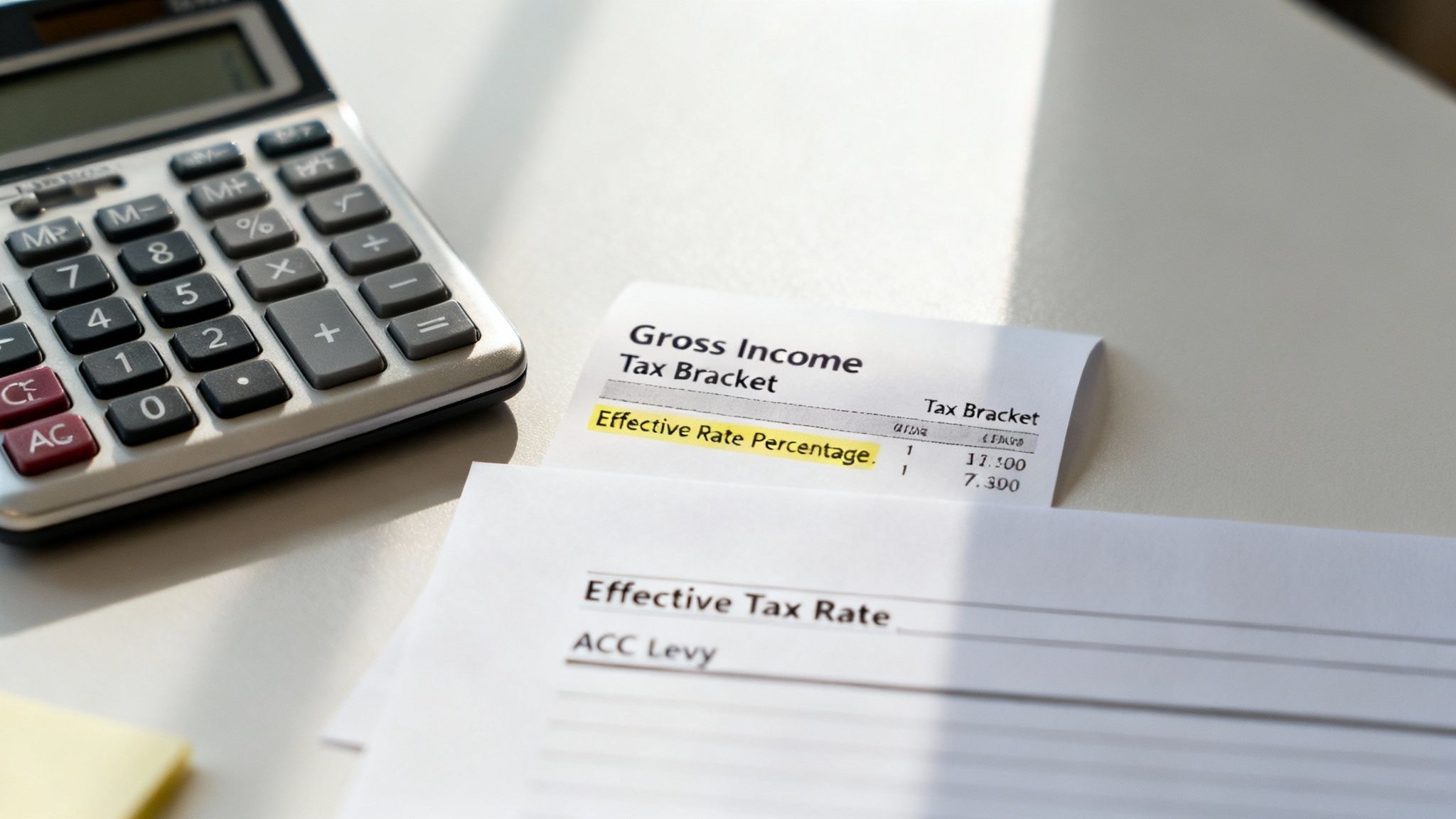
Knowing which tax bracket you fall into is a great start, but it doesn’t tell the whole story. To really get a grip on what you’re paying, you need to look at your Effective Marginal Tax Rate (EMTR). This is the real rate you pay on the next dollar you earn once other costs, like the ACC levy, are factored in.
Think of it like this: your tax bracket is the sticker price, but your EMTR is the final “drive-away” cost. It’s the true cost of earning that extra dollar, which is crucial for making smart financial decisions. For a refresher on the brackets themselves, have a look at our simple guide to understanding NZ marginal tax rates.
This isn’t just a technical detail—it’s incredibly practical. Knowing your EMTR helps you figure out if that extra project or those overtime hours are truly worth it. Pushing your income up might tip your next dollar earned into a zone where the tax and levy combo takes a much bigger bite than you’d think.
What Is Included in Your EMTR
Your effective rate isn’t just your income tax. It’s a more honest reflection of your situation because it includes other mandatory payments that reduce your take-home pay.
The main one to be aware of is the Accident Compensation Corporation (ACC) Earners’ Levy. For the 2024-2025 period, this is set at 1.60% on any earnings up to $142,528. When you add this to your marginal tax rate, you start to see what you’re actually paying.
For a practical example, let’s say your income is $65,000. You’re in the 30% tax bracket. Your EMTR isn’t a flat 30%. Once you tack on the ACC levy, you’re actually losing 31.6% of every extra dollar you earn within that bracket. That small difference really adds up over a year and can affect your bottom line.
While our headline tax rates can seem high, it’s worth remembering that various social support policies often bring the final tax burden down for many Kiwis. A Treasury study pointed out that while the top rate is 39%, about 41% of people face an EMTR under 25%, and 53% have rates between 25% and 50%. This shows that for most of us, the actual rate is less than our top marginal bracket suggests.
Getting a handle on your true tax rate can feel like a headache, especially when you’re busy running a business or managing investment properties. For an affordable, down-to-earth chat about your specific situation, the chartered accountants at Business Like NZ Ltd are here to help. We’re proud to support Auckland businesses and property investors.
Tax Essentials for Small Businesses
Stepping into the world of small business in New Zealand means your tax situation changes quite a bit. Suddenly, you’re not just an employee with tax sorted automatically. You’re dealing with different structures and rules, and getting your head around them is crucial for keeping your finances healthy and the IRD happy.
If you’ve set up your business as a company, the tax calculation is nice and simple. There’s a flat company tax rate of 28% on your net profit. This is a world away from being a sole trader, where all your business income just gets added to your personal earnings and taxed at those progressive rates we talked about earlier.
As a sole trader, your best friend is knowing what you can claim as a business expense. Every legitimate deduction lowers your taxable income, which means less tax to pay. If you’re unsure where to start, our comprehensive guide to tax deductions for sole traders is a fantastic resource for getting it right.
What Is Provisional Tax
Once you’re self-employed or running a business, you’ll hear the term “provisional tax” a lot. Don’t let it intimidate you. Think of it as simply paying your income tax in smaller chunks during the year, instead of being hit with one massive bill at the end. It’s a pay-as-you-go system that seriously helps with cash flow.
So, who has to pay it? Generally, if you had more than $5,000 to pay in tax at the end of last year, you’ll be on the hook for provisional tax this year. It’s the IRD’s way of making sure people with income that isn’t taxed at the source (like PAYE for employees) are still contributing regularly.
Provisional tax isn’t some extra tax on top of what you already owe. It’s a prepayment of your income tax for the year. Every instalment you pay is a credit towards your final tax bill.
A Practical Example of Provisional Tax
Let’s put this into a real-world scenario. Say you’re a freelance graphic designer in Auckland, and your final tax bill last year came to $9,000. That’s over the $5,000 threshold, so this year, it’s provisional tax time.
The IRD’s standard method is to take last year’s tax bill and add a little extra (usually 5%) to estimate this year’s.
Here’s how that breaks down:
- Last Year’s Tax: $9,000
- Standard Uplift (5%): $450
- This Year’s Estimated Tax: $9,450
This $9,450 is then usually split into three equal payments of $3,150 due on specific dates throughout the year. Easy.
Juggling company rates, provisional tax, and deductions can definitely feel overwhelming. For Auckland businesses and property investors who want clear, no-nonsense advice, Business Like NZ Ltd provides affordable, down-to-earth support from chartered accountants who can help you navigate it all without the stress.
How GST Works for Your Business

If you’re in business in New Zealand, you’ll get familiar with Goods and Services Tax (GST) pretty quickly. It’s a 15% tax that gets added to the price of almost everything sold here. For businesses, the magic number is $60,000. If your annual turnover hits or exceeds that amount in any 12-month period, you’re legally required to register for GST.
Once registered, you essentially become a tax collector for the government. You add GST to your prices, collect it from your customers, and then pass it along to Inland Revenue. Think of it as money that’s just passing through your accounts—it never really belongs to you.
What if you’re earning less than $60,000? You can still choose to register for GST voluntarily. This can be a savvy move, especially for new businesses, because it lets you claim back the GST you pay on your own business expenses, from a new laptop to your accountant’s fees.
A Practical GST Example in an Auckland Cafe
Let’s put this into a real-world context. Imagine you own a popular little cafe in an Auckland suburb. You’re constantly dealing with GST, both coming in and going out.
When a customer buys a flat white for $5.50, that price already includes GST. You pocket the whole $5.50 for now, but part of that is earmarked for the IRD. On the flip side, when you buy a big bag of coffee beans from your supplier for $115, that price also includes GST. The crucial difference is that as a GST-registered business, you get to claim that portion back.
It’s a simple balancing act. At the end of your filing period, you just subtract the total GST you’ve paid on business costs from the total GST you’ve collected from sales. The difference is what you owe the IRD. If it turns out you’ve paid more GST than you’ve collected, you’ll get a refund.
Filing Your GST Return
This whole process comes together when you file your GST return. It’s not as scary as it sounds. Here’s how our cafe owner would do it:
- Step 1: Tally up GST collected. Add up the 15% GST from every single sale—every coffee, scone, and sandwich sold during the period. Let’s say it’s $3,000.
- Step 2: Tally up GST paid. Calculate the 15% GST you paid on all your business purchases—milk, coffee beans, rent, power bills, you name it. Let’s say that comes to $1,800.
- Step 3: Find the difference. Subtract the total GST you paid from the total GST you collected ($3,000 – $1,800 = $1,200). That final number, $1,200, is what you need to pay to the IRD.
Keeping on top of this is not just about staying compliant; it’s fundamental to managing your cash flow properly. If you want to dive deeper, we break it all down in our complete GST New Zealand business guide.
Managing GST doesn’t have to be a headache. If you’re an Auckland business owner or property investor who could use some help, the team at Business Like NZ Ltd offers practical, no-nonsense support. We’re affordable, down-to-earth chartered accountants who can make it all seem simple.
A Guide to Property Investor Tax
Dipping your toes into the property market, especially somewhere as lively as Auckland, means you’re playing with a different set of tax rules. If you’ve become a landlord or investor, getting your head around your tax obligations is the first step to making your investment work for you, not against you.
At its core, any money you earn from rent is taxable income. Simple as that. This rental income gets added on top of your other earnings (like your salary from a day job), and you’re taxed on the whole lot at your personal income tax rate. The real game is figuring out your net rental income—that’s the profit you have left after you’ve subtracted all your legitimate property expenses.
This is where good bookkeeping becomes your best friend. You can legally reduce your taxable income by claiming a whole host of property-related expenses. Think of it like a ledger: the rent comes in one column, and all the costs of keeping the property running go in another.
Common Deductible Expenses
For any Auckland property investor, tracking every single dollar you spend is non-negotiable. So many of the day-to-day costs of owning and managing a rental can be claimed back at tax time.
Of course, knowing what you can claim is half the battle. To help you get started, here’s a rundown of some of the most common expenses you should be keeping records for.
| Expense Category | Description & Examples |
|---|---|
| Rates & Insurance | This is a straightforward one. Your annual council rates and the insurance premiums for the rental property are fully deductible. |
| Repairs & Maintenance | The cost of general upkeep is claimable. Think fixing a leaky tap, patching a hole in the wall, or repairing a fence. This doesn’t cover big improvements that add value, though—that’s a different category. |
| Professional Fees | If you pay for professional help, you can claim it. This includes fees for property managers, accountants, or lawyers who provide services directly related to your rental. |
| Mortgage Interest | This is a big one for most investors. You can claim the interest portion of the mortgage payments for your rental property. |
| Travel Costs | Costs for travelling to and from your rental property for inspections or maintenance can often be claimed. |
This isn’t an exhaustive list, but it covers the main expenses that trip up new investors. The golden rule is: if you spent it on the property to earn rental income, there’s a good chance it’s deductible.
Key Rules to Be Aware Of
Beyond the everyday running costs, there are a few bigger tax rules you absolutely must know about.
The bright-line property rule is probably the most talked-about. In a nutshell, if you sell a residential property within a certain timeframe (10 years for most properties bought on or after 27 March 2021), any profit you make from the sale might be taxed as income. It’s designed to catch short-term property speculation, and it’s crucial to understand how it applies to you.
Another key concept is depreciation. This allows you to claim a deduction for the wear and tear on assets inside the property—things like carpets, ovens, or heat pumps. These are known as ‘chattels’, and claiming depreciation on them can make a real difference to your final tax bill.
Getting this right means you only pay tax on your true profit, not your total rental revenue. It’s the difference between guessing your tax and knowing it, which can have a big impact on your yearly returns.
To really get the most out of your investment, it’s also worth exploring different real estate investment tax strategies.
Navigating the world of rental income, expenses, and rules like the bright-line test can feel overwhelming. For Auckland property investors who just want clear, practical advice, Business Like NZ Ltd offers affordable, down-to-earth support from chartered accountants who specialise in making property tax straightforward.
How Does NZ’s Tax System Stack Up Globally?
It’s a fair question: how much tax are we really paying in New Zealand compared to other developed countries? While we’re known for having a pretty straightforward tax system, our rates and when they kick in can look quite different from places like the United States, which often reflects different social and economic priorities.
One of the biggest eye-openers is how soon our top tax rate applies. It’s these kinds of differences that really shape our financial landscape on the world stage.
A Look at Top Tax Rates
Let’s get straight to the numbers. In New Zealand, the top marginal tax rate is 39%, and it applies to every dollar you earn over $180,000.
Now, let’s hop over to the U.S. Their top federal tax rate is a little lower at 37%. But here’s the kicker: that rate only applies to income over a much, much higher threshold—USD $578,125 for single filers in 2025. It just goes to show how different tax systems are built to achieve very different national goals. If you’re curious, you can learn more about NZ and US tax structures.
These numbers tell a story. They reveal a country’s core philosophy on wealth distribution and public services. A lower top threshold, like ours, usually signals a stronger focus on funding social programmes through progressive taxation.
Seeing where we fit in the global picture can give you a clearer perspective on your own tax situation. For Auckland business owners and property investors who want clear, practical tax advice, our friendly team at Business Like NZ Ltd is here to help. We’re affordable, down-to-earth chartered accountants focused on supporting our local community.
Making Your Tax Journey Easier
Let’s be honest, figuring out your tax obligations in New Zealand can feel like a headache. You’re juggling personal tax brackets, company rates, GST, and maybe even provisional tax. It’s a lot to keep track of, whether you’re running a small business, investing in property, or working for yourself.
Getting it right from the start saves you from costly mistakes down the line. The goal is simple: pay exactly what you owe, and not a dollar more.
But here’s the thing—you don’t have to go it alone. Trying to untangle complex tax rules can eat up hours you’d rather spend running your business or growing your property portfolio. Getting professional guidance can turn a confusing process into a straightforward one.
Getting the Right Support
For any Auckland business or property investor, finding an expert to have in your corner is one of the smartest moves you can make. A good accountant does more than just crunch the numbers; they give you clarity and peace of mind, making sure every box is ticked.
To make life even simpler, many tax professionals and businesses now use tools like hosted tax preparation software like Drake Tax to manage their filings efficiently. It’s all about working smarter, not harder.
The goal is to make tax a straightforward part of your financial routine, not a source of anxiety. With the right support, you can be certain your tax affairs are accurate, timely, and optimised for your specific situation.
When you’re ready to take the stress out of tax, it’s about finding advisors who get what you’re trying to achieve.
At Business Like NZ Ltd, we’re affordable, down-to-earth chartered accountants who love supporting Auckland’s small businesses and property investors. We skip the jargon and give you clear, practical advice that actually makes sense. Flick us a message for a no-obligation chat, and let’s see how we can make your tax journey a whole lot easier.
Got Questions About NZ Tax? We’ve Got Answers.
We’ve walked through the ins and outs of New Zealand’s tax system, from individual rates to what it means for your business. But often, it’s the specific, everyday questions that pop up.
Here are some quick, clear answers to the things we get asked most often.
Is the Interest on My Savings Account Taxed?
Yes, it absolutely is. Any interest you earn from a bank account is considered income, so it’s taxable.
Your bank usually handles this for you by deducting Resident Withholding Tax (RWT) before the interest even hits your account. Just make sure you’ve given them your correct tax rate so you don’t end up with a surprise bill (or a missed refund) come tax time. For example, if your personal tax rate is 30% but the bank only withholds 17.5%, you’ll have to pay the difference to IRD later.
What’s the Company Tax Rate in NZ?
For a registered company in New Zealand, the tax rate is a straight 28%.
This flat rate is applied to the company’s net profit—that’s the money left after all the expenses are paid but before any is paid out to shareholders. It’s a lot more straightforward than the tiered income brackets that individuals and sole traders use.
I Work From Home. Can I Claim Expenses as an Employee?
This is a common point of confusion. As a salaried or waged employee, you generally can’t claim deductions for your home office costs.
Your employer might give you a tax-free allowance to help with power and internet, but you can’t personally claim these against your income. It’s a different story for self-employed people and business owners, who can—and should—claim a portion of their home running costs as a business expense.
Getting your head around these details is a great start, but let’s be honest, tax can still feel like a maze.
At Business Like NZ Ltd, we’re affordable, down-to-earth chartered accountants supporting Auckland businesses and property investors every day. If you’re looking for clear, practical help without the confusing jargon, get in touch with us today.