
What is Provisional Tax
Provisional tax trips up more Auckland businesses than you might expect. If your tax bill tops $5000, you could be on the hook to pay chunks of your annual tax early—long before the usual deadline. Seems a bit harsh, right? Here’s the real surprise. Once you nail the system, those advance payments can actually make running your business less stressful instead of more.
Table of Contents
- Understanding What Is Provisional Tax
- Who Needs To Pay Provisional Tax In Auckland
- How Provisional Tax Works For Businesses And Investors
- Tips For Managing Provisional Tax In 2025
Quick Summary
| Takeaway | Explanation |
|---|---|
| Provisional Tax Mechanism | Provisional tax is a prepayment system for income tax requiring businesses to make advance payments based on expected annual income, aiming to spread the financial burden across multiple installments. |
| Categories of Taxpayers | Individuals and businesses with annual residual income tax exceeding $5,000, including self-employed professionals, rental property owners, and business owners, must pay provisional tax. |
| Calculation Methods | There are four main methods for calculating provisional tax: Standard Uplift, Estimation, GST Ratio, and Accounting Income Method (AIM), each offering unique advantages suitable for varying business situations. |
| Strategic Financial Planning | Successful tax management requires meticulous record-keeping to track income, monitor expenses, and prepare for audits, which supports accurate provisional tax calculations. |
| Technology and Professional Guidance | Implementing technology, such as cloud-based accounting software, and consulting tax professionals can enhance the efficiency of provisional tax management, ensuring compliance and optimal financial planning. |
Understanding What is Provisional Tax
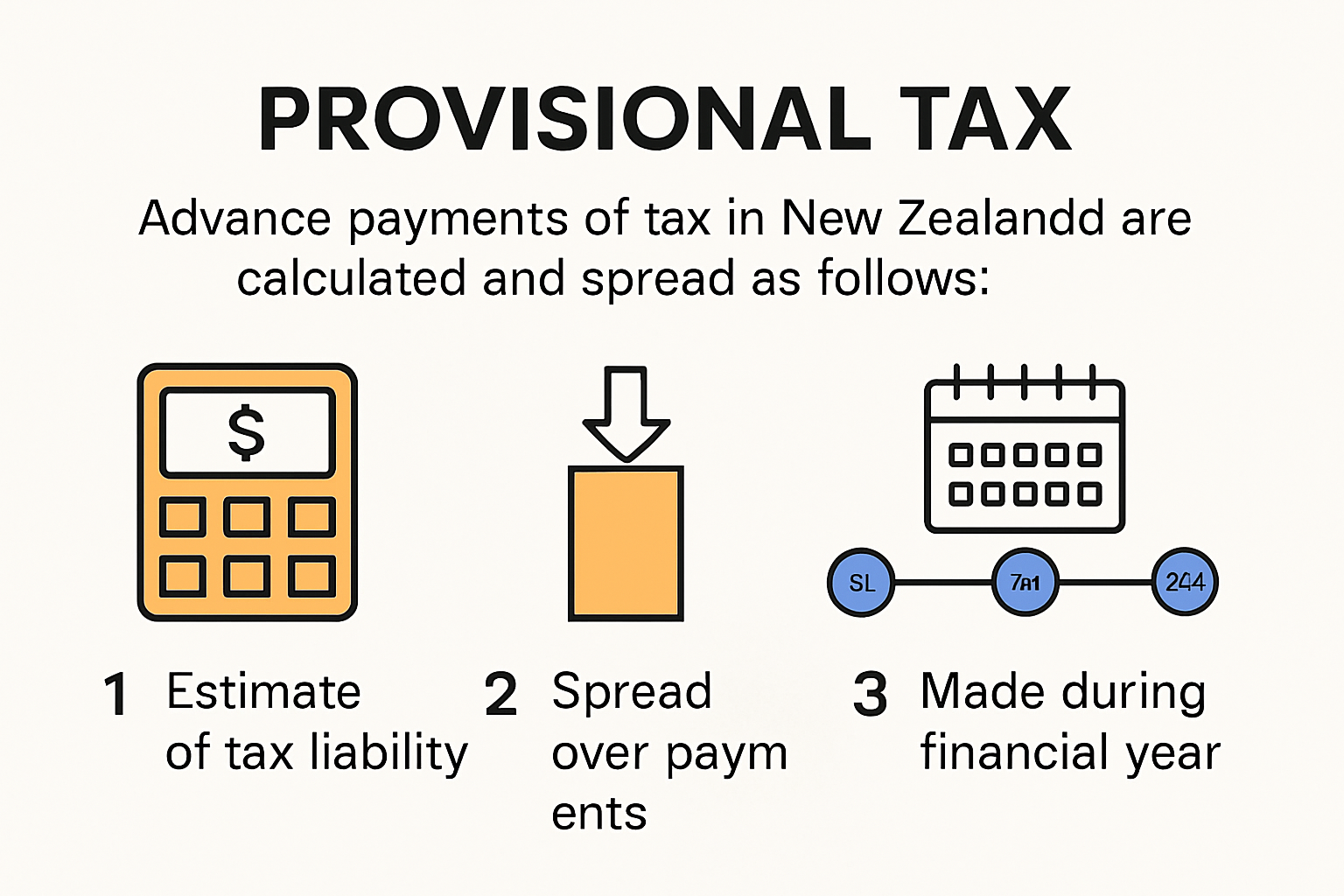
Provisional tax represents a critical financial obligation for New Zealand businesses, designed to help manage annual income tax payments throughout the year. Unlike traditional tax payment systems, provisional tax requires businesses to make advance payments based on their expected annual income, spreading the financial burden across multiple installments.
The Basics of Provisional Tax Mechanism
At its core, provisional tax is a prepayment system for income tax that applies to individuals and businesses with annual residual income tax exceeding $5,000. Learn more about tax compliance strategies to ensure smooth financial management. The system allows taxpayers to pay their estimated income tax in installments, rather than facing a substantial lump sum payment at the end of the tax year.
According to Inland Revenue Department, the primary goal of provisional tax is to help taxpayers manage their cash flow more effectively. By breaking down tax obligations into smaller, more manageable payments, businesses can better plan their financial resources and avoid unexpected large tax bills.
Calculation Methods for Provisional Tax
Business owners have multiple approaches to calculating their provisional tax obligations. The New Zealand tax system offers four primary methods for determining and paying provisional tax:
- Standard Uplift Method: Calculates payments based on 105% of the previous year’s residual income tax (or 110% if the prior year’s tax return remains unfiled).
- Estimation Method: Allows businesses to estimate their expected income and tax liability for the current year.
- GST Ratio Method: Uses GST returns to estimate provisional tax payments.
- Accounting Income Method (AIM): Provides a more dynamic approach that aligns tax payments with actual business income.
Each method offers unique advantages, and the most suitable approach depends on your specific business circumstances, income stability, and financial reporting practices. Business owners should carefully evaluate their options and potentially consult with a financial professional to determine the most appropriate method for their situation.
The provisional tax system introduces both challenges and opportunities for New Zealand businesses. While it requires additional financial planning and tracking, it ultimately provides a more predictable and manageable approach to meeting tax obligations. By understanding the mechanics of provisional tax, business owners can develop more effective financial strategies and maintain compliance with tax regulations.
To help you compare at a glance, here is a table summarising the key features of the four provisional tax calculation methods discussed above.
| Method | How It Works | Best For | Key Advantage |
|---|---|---|---|
| Standard Uplift | Pay 105% of last year’s RIT (or 110% if unfiled) | Consistent income businesses | Simple, straightforward |
| Estimation | Estimate current year’s income and tax payable | Fluctuating or declining earnings | Flexibility |
| GST Ratio | Pays based on a ratio of GST turnover using GST returns | GST-registered entities with regular GST | Matches tax to GST activity |
| Accounting Income Method (AIM) | Pay based on actual business income calculated using approved software | Businesses with irregular income streams | Matches tax to real earnings |
Who Needs to Pay Provisional Tax in Auckland
Provisional tax requirements in Auckland apply to a diverse range of business professionals and income earners who meet specific financial thresholds. Understanding whether you fall into this category is crucial for maintaining tax compliance and avoiding potential penalties.
Categories of Provisional Taxpayers
According to the Inland Revenue Department, several key groups are typically required to pay provisional tax. Learn about tax compliance strategies to ensure you meet your obligations. These categories include:
- Self-Employed Professionals: Individuals generating income through independent work, including consultants, freelancers, and contractors.
- Rental Property Owners: Investors earning income from residential or commercial property rentals in Auckland and surrounding regions.
- Business Owners: Entrepreneurs running small to medium enterprises with annual income exceeding specific tax thresholds.
- Partnership Income Earners: Individuals receiving income from business partnerships.
- Overseas Income Earners: New Zealand residents generating income from international sources.
Financial Thresholds and Qualification Criteria
The primary trigger for provisional tax obligations is the residual income tax (RIT) threshold. New Zealand tax regulations specify that individuals and businesses must pay provisional tax if their RIT for the previous tax year exceeds $5,000. This means that if your tax liability from the previous year was more than $5,000, you are likely required to make advance tax payments.
Businesses in Auckland should carefully assess their financial situation. For instance, a freelance graphic designer earning $80,000 annually or a small consulting firm with significant project income would typically fall under provisional tax requirements. Real estate investors with multiple rental properties in Auckland are also prime candidates for this tax payment system.
It is important to note that the provisional tax system applies regardless of your business structure. Whether you operate as a sole trader, partnership, or limited company, the same fundamental rules apply. The goal is to spread tax payments throughout the year, reducing the financial burden of a large end-of-year tax bill.
Professional advice can be invaluable in navigating these requirements. Each business and individual has unique financial circumstances, and consulting with a tax professional can help you understand your specific provisional tax obligations, choose the most appropriate calculation method, and ensure compliance with New Zealand tax regulations.
Here’s a table summarising the main categories of people and businesses required to pay provisional tax in Auckland and what triggers the obligation.
| Category | Description | Typical Income Source | Triggers Provisional Tax |
|---|---|---|---|
| Self-Employed Professionals | Individuals working as consultants, freelancers, or contractors | Personal services, project contracts | Residual income tax > $5,000 |
| Rental Property Owners | Investors renting out residential or commercial properties | Rental income | Residual income tax > $5,000 |
| Business Owners | Small-medium enterprise entrepreneurs | Business trading income | Residual income tax > $5,000 |
| Partnership Income Earners | Members of business partnerships | Share of partnership profits | Residual income tax > $5,000 |
| Overseas Income Earners | NZ residents with income from overseas sources | International salary/investments | Residual income tax > $5,000 |
How Provisional Tax Works for Businesses and Investors
Provisional tax represents a strategic financial mechanism for businesses and investors to manage their annual tax obligations systematically. The process involves making advance tax payments based on estimated annual income, helping to distribute tax liabilities more evenly throughout the financial year.
Tax Payment Installation Strategies
Businesses and investors have multiple approaches to managing their provisional tax payments. Explore comprehensive tax planning strategies to optimize your financial management. According to the Inland Revenue Department, there are four primary methods for calculating and paying provisional tax:
- Standard Uplift Method: Automatically increases the previous year’s residual income tax by 105% (or 110% if the prior year’s return is unfiled).
- Estimation Method: Allows taxpayers to estimate their expected income and calculate tax payments accordingly.
- GST Ratio Method: Uses GST returns to determine provisional tax installments.
- Accounting Income Method (AIM): Provides a dynamic approach that aligns tax payments directly with actual business income.
Practical Implementation for Auckland Businesses

The New Zealand tax system offers flexibility in how businesses manage their tax obligations. For instance, the Accounting Income Method (AIM) is particularly beneficial for businesses with irregular income streams. This method allows businesses to pay provisional tax only when they generate profit, using approved accounting software to calculate precise payments.
Real estate investors and small business owners in Auckland can particularly benefit from understanding these payment strategies. For example, a consulting firm with seasonal income might find the AIM method more suitable, as it allows tax payments to align directly with actual business earnings. Conversely, a rental property investor with more consistent income might prefer the standard uplift method for its simplicity.
Timing is crucial in provisional tax management. Typically, taxpayers make three installment payments throughout the year. These payments are usually due on the 28th of August, January, and May, depending on the chosen accounting period. By spreading tax payments, businesses can better manage cash flow and avoid the financial strain of a substantial year-end tax bill.
It is essential to recognize that choosing the right provisional tax method depends on individual business circumstances. Factors such as income stability, business structure, and financial reporting practices all play critical roles in determining the most appropriate approach. Businesses should carefully evaluate their options, potentially consulting with a financial professional to develop the most effective tax strategy.
Ultimately, the provisional tax system aims to create a more manageable and predictable tax payment process. By understanding and strategically implementing these methods, Auckland businesses and investors can maintain financial compliance while optimizing their cash flow management.
Tips for Managing Provisional Tax
Managing provisional tax effectively requires strategic planning, proactive financial tracking, and a comprehensive understanding of New Zealand’s tax regulations. Businesses and investors in Auckland need to adopt sophisticated approaches to optimize their tax management and minimize potential financial risks.
Strategic Financial Planning and Record Keeping
Discover advanced tax compliance strategies to streamline your financial management. Maintaining accurate and detailed financial records is fundamental to successful provisional tax management. According to Business.govt.nz, meticulous record keeping enables businesses to:
- Track Income Precisely: Document all revenue streams comprehensively.
- Monitor Expenses: Categorize and record business expenditures systematically.
- Prepare for Audits: Maintain organized financial documentation.
- Support Tax Calculations: Provide reliable data for provisional tax estimations.
Advanced Payment and Cash Flow Management
Tax pooling presents another advanced management technique. Tax pooling allows taxpayers to consolidate provisional tax payments, potentially reducing interest rates and avoiding late payment penalties. This approach enables businesses with varying income patterns to offset underpayments through collective pooling mechanisms.
Learn more: Tax Pooling: How This Inland Revenue-Approved Strategy Can Save You Money
Technology and Professional Guidance
Embracing technological solutions and seeking professional advice are crucial for effective provisional tax management in 2025. Modern accounting software can automate many aspects of tax calculation, particularly through the Accounting Income Method (AIM), which calculates tax payments based on actual business income.
Business owners should consider several key strategies:
- Invest in cloud-based accounting platforms
- Schedule regular financial reviews
- Consult with tax professionals
- Stay informed about changing tax regulations
- Use predictive financial modeling
For Auckland businesses, understanding and implementing these strategies can transform provisional tax from a complex obligation into a manageable aspect of financial planning. The goal is not just compliance, but strategic financial management that supports business growth and stability.
Ultimately, successful provisional tax management in 2025 requires a proactive, informed approach. By combining technological tools, professional advice, and strategic planning, businesses can navigate their tax obligations efficiently and maintain robust financial health.
Frequently Asked Questions
What is provisional tax?
Provisional tax is a prepayment system for income tax in New Zealand that requires businesses to make advance payments based on their expected annual income, helping to spread tax obligations across multiple installments throughout the year.
Who needs to pay provisional tax in Auckland?
Individuals and businesses in Auckland must pay provisional tax if their residual income tax (RIT) for the previous year exceeds $5,000. This includes self-employed professionals, rental property owners, and business owners.
What are the methods for calculating provisional tax?
There are four primary methods for calculating provisional tax in New Zealand: Standard Uplift Method, Estimation Method, GST Ratio Method, and Accounting Income Method (AIM). Each method caters to different business circumstances and income patterns.
How can Auckland businesses manage provisional tax payments effectively?
Auckland businesses can manage provisional tax payments by maintaining accurate financial records, utilizing accounting software, considering tax pooling, and consulting with tax professionals for tailored advice.
Take the Uncertainty Out of Provisional Tax for Your Auckland Business
Are you feeling overwhelmed by the challenges of provisional tax and advance payments? Many Auckland business owners struggle with irregular income, changing tax rules and cash flow worries. It is normal to feel pressure trying to keep up with exact payments, record-keeping and finding the right calculation method. These hurdles can threaten your business’s sense of control and peace of mind.
You are not alone, and you do not need to manage these complexities on your own. At Business Like NZ Ltd, we specialise in helping small and medium-sized Auckland businesses master provisional tax, stay compliant and improve cash flow. Our team offers jargon-free advice, cloud-based software support and practical tax planning. If you are ready to get ahead, book your free consultation with us today and discover how easier tax management can give you back your confidence and clarity.