
Your Guide to NZ Company Registration
So, you’re ready to start a business in New Zealand? That’s a fantastic move. The good news is that the whole process of getting your company registered is refreshingly straightforward. You’ll basically reserve a unique name online, pull together the details of your directors and shareholders, and then file everything through the Companies Office website. Honestly, you can often knock it all out in a few hours.
Your First Moves in NZ Company Registration
Getting your company officially set up in New Zealand is a huge milestone. It’s more than just filling out forms—it’s the moment your business idea becomes a real, legal entity. Luckily, New Zealand has a global reputation for being incredibly business-friendly, so it’s not nearly as intimidating as you might think. This guide is your roadmap, walking you through everything from that initial spark of an idea to your ongoing responsibilities as a company director.
A little bit of prep work now will save you a world of headaches later. Seriously. Getting your key decisions sorted before you even look at the online forms is the secret to a smooth ride.
Why New Zealand Is a Great Place to Start a Business
The entrepreneurial buzz in New Zealand is real. You can see it in the numbers—specifically, the country’s new business density. This metric tracks new company registrations per 1,000 people of working age. Back in 2022, that number was a whopping 16.32. Think about that: for every 1,000 Kiwis aged 15-64, over 16 new businesses were officially born. This kind of activity points to a really supportive environment for new ventures, underpinned by a slick registration system. If you’re a data geek, you can dig into more stats on New Zealand’s business climate on Trading Economics.
The government makes it easy with clear, online tools, and your main port of call will be the New Zealand Companies Office.
Here’s a peek at their homepage, which you’ll get very familiar with.

This site is your one-stop shop for everything from the initial setup to filing your annual returns down the road.
Your Pre-Registration Checklist for NZ Companies
Before you jump into the online application, it’s mission-critical to have your ducks in a row. It just saves so much time and stops you from having to go back and fix things. I’ve put together a quick table outlining the essential info you need to have ready. Trust me, spending 30 minutes on this checklist will save you hours of frustration.
The biggest mistake I see new entrepreneurs make is rushing into the application unprepared. Deciding on your directors, shareholders, and physical address before you start is the single best thing you can do for a hassle-free registration.
| Checklist Item | Key Consideration | Why It Matters |
|---|---|---|
| Company Name | Is it unique and available? Use the ONECheck tool to verify. | Your name can’t be identical or even “nearly identical” to an existing one. This avoids brand confusion and potential legal fights. |
| Director(s) | Who’s running the show? At least one director must live in NZ (or Australia). | Directors have serious legal duties. The residency requirement is a strict, non-negotiable rule. |
| Shareholder(s) | Who owns the company? This can be you, other people, or even another company. | Ownership determines who gets profits and who has control. You must decide on the number of shares each owner gets. |
| Registered Office | What’s your physical NZ address? A P.O. Box won’t cut it. | This is your official address for legal documents. The Companies Office needs a real street address. |
| Address for Service | Where can documents be physically delivered? Can be different from the registered office. | This is to make sure you actually receive important mail. It could be your home, your office, or even your accountant’s address. |
Having these five things sorted makes the actual application process a simple matter of data entry. It’s all about the prep work.
Choosing Your Company Name and Legal Structure

This is the point where your business idea starts to feel real. Nailing down a great name and the right legal framework are the first big moves you’ll make. They set the stage for your company’s identity and its financial future, so getting them right from the get-go is a massive step in your NZ company registration journey.
Let’s dive into the fun part first—the name. It’s more than just finding something cool; it has to be legally up for grabs. Honestly, the last thing you want is to pour your heart into building a brand only to find out you can’t actually own the name.
Your absolute best friend for this task is the government’s ONECheck tool. It’s a brilliant little resource that checks your potential name against the Companies Register, web domains, and even social media handles, all in one go.
Imagine you want to start a coffee shop called “Kiwi Roast.” A quick search on ONECheck might show the company name is free, but the .co.nz domain and the Instagram handle are gone. That’s a huge bit of insight that can save you from a major branding headache down the line. A solid name is distinctive, easy to spell, and available everywhere you want to be online.
Getting the Most Out of the ONECheck Tool
Don’t just plug in your first idea and call it a day. The trick is to have a shortlist ready to go. Think of it as a creative sprint.
- Be Unique: A name like “Auckland Plumbing Solutions” is fine, but it’s pretty generic. Something like “AquaFix Plumbing” has a bit more personality and is easier to brand.
- Watch for Restricted Words: You can’t just toss words like ‘Bank’, ‘Trust’, or ‘Royal’ into your name without a very good reason. The Companies Office will flag names that sound like they have an official connection to the government or other major institutions when they don’t.
- Check for Clones: The law prevents you from registering a name that’s “almost identical” to one that already exists. “Super Builders Limited,” for instance, is probably too close for comfort to “Superior Builders Limited” and would likely get rejected.
Once you’ve found a name you love and it’s available, you can reserve it through the Companies Office website. This puts a 20 working day hold on the name, giving you plenty of breathing room to sort out the rest of your paperwork without someone else swooping in.
Picking a name is more than a creative exercise; it’s your first legal hurdle. A name that is confusingly similar to a competitor’s isn’t just bad for marketing—it can get your registration application rejected or even lead to legal action down the track.
Picking the Right Legal Structure for Your Business
This is, without a doubt, one of the most critical decisions you’ll make when setting up. The structure you choose directly impacts your taxes, how much personal risk you’re exposed to, and the amount of admin you’ll be doing.
Let’s break down the main options in plain English.
Sole Trader
This is the simplest way to get started. You are the business. There’s no legal distinction between your personal and business finances, which means your personal assets (like your house or car) could be on the line if the business gets into debt. It’s super easy to set up, which is why it’s a go-to for many freelancers and contractors.
Partnership
Think of this as a sole trader setup, but with two or more people. You and your partners share the profits, but you also share 100% of the liability for any business debts. This is called “joint and several liability,” and it’s a big deal. If your partner racks up a huge debt under the business name, you could be held personally responsible for the entire amount.
Limited Liability Company (LLC)
This is the most popular structure for businesses in New Zealand that plan to grow. An LLC is its own legal person, totally separate from its owners (the shareholders). This creates a vital shield for your personal assets. Your liability is typically limited to whatever you’ve invested in the company.
Here’s a quick side-by-side look to help you weigh it up:
| Feature | Sole Trader | Partnership | Limited Liability Company |
|---|---|---|---|
| Personal Liability | Unlimited | Unlimited | Limited to investment |
| Legal Status | You are the business | You & partners are the business | Separate legal entity |
| Setup Complexity | Very simple | Simple | More formal, requires registration |
| Ongoing Admin | Minimal | Low | Annual returns, formal records |
For most people serious about building a business—especially if you plan to hire staff, take on investment, or just want to protect your family home—forming a limited liability company is the smartest path forward. Yes, there’s a bit more paperwork involved, but the peace of mind it buys you is priceless.
Learn more: Choosing the right Business Structure
Let’s Walk Through the Online Registration Process
Alright, you’ve got your company name sorted and decided a limited liability structure is the way to go. Now for the main event—the actual online application. This is where your NZ company registration goes from an idea to a reality.
Don’t sweat it. The New Zealand Companies Office has actually made this pretty painless, but I’ll walk you through it to help you dodge any common slip-ups.
The very first thing you need is a RealMe account. Think of it as your digital passport for dealing with various government departments in NZ, not just the Companies Office. It’s smart to get this set up before you even start the company application.
Here’s what the login page looks like so you know you’re in the right place.
Once your RealMe is good to go, you can jump straight into the company registration portal.
Plugging in Your Core Company Details
The online form will ask for all the key details you’ve already figured out. This is where you’ll enter the specifics about your directors, registered office, and shareholders. Getting this stuff right the first time is crucial.
You’ll need to provide the full legal names, home addresses, and dates of birth for every director. This isn’t just busywork; it’s a legal requirement for transparency. And remember, at least one of your directors has to either live in New Zealand or live in Australia and be a director of an Australian-registered company.
One thing that often trips people up is the difference between a ‘registered office’ and an ‘address for service’. Here’s the breakdown:
- Registered Office: This has to be a physical street address in New Zealand—no P.O. Boxes allowed! It’s the official spot where someone could serve legal documents to your company.
- Address for Service: This is where you want general mail and notices sent. It can be the same as your registered office, your home, or maybe even your accountant’s office.
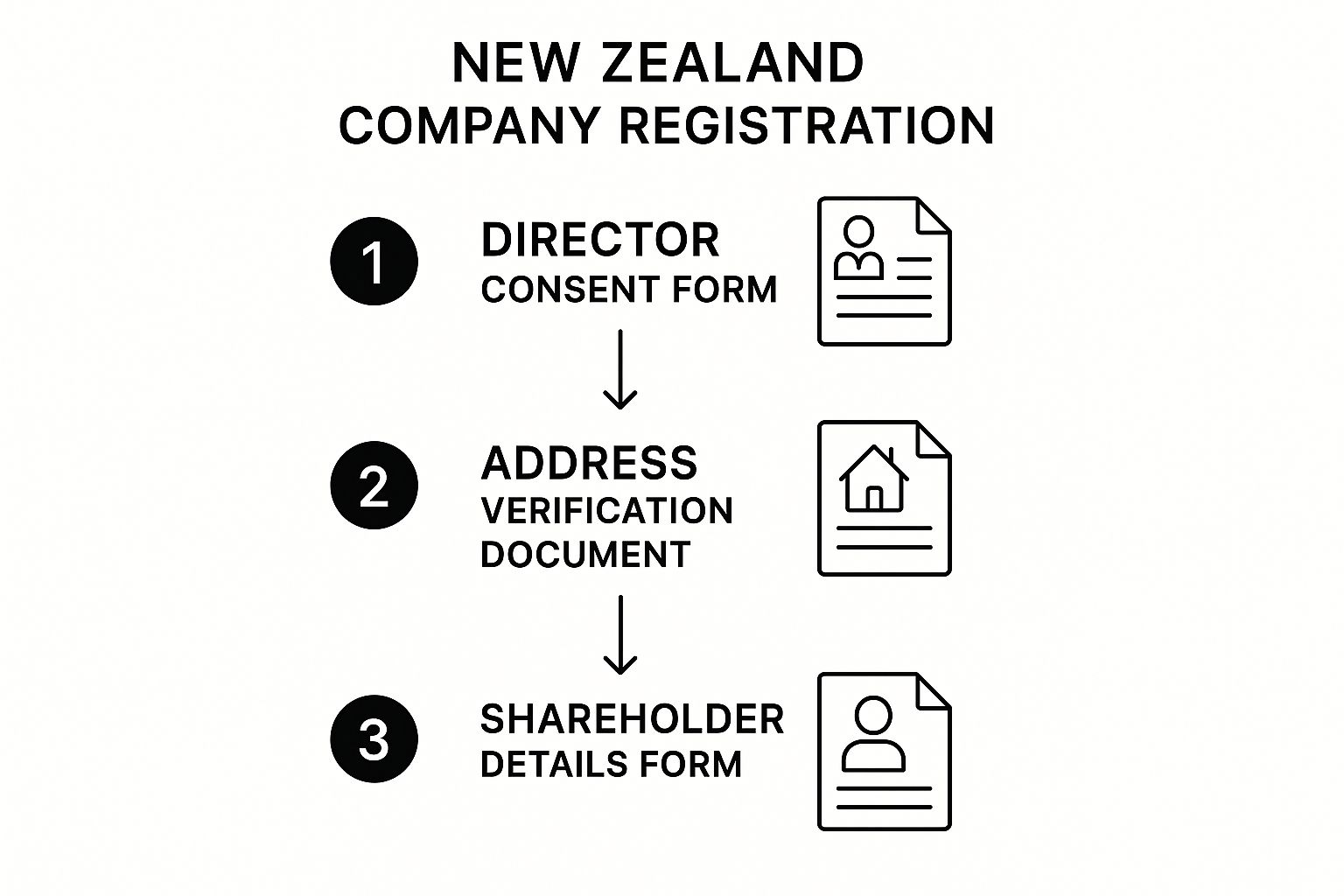
Pro Tip: Before you punch in anyone’s name, make sure you have written consent from every single director and shareholder. The Companies Office can ask for proof, and not having it will bring your registration to a screeching halt.
It’s amazing to see how many people are starting businesses here. In 2022 alone, an incredible 54,348 new businesses were registered. That kind of volume shows just how accessible the whole system is, feeding a vibrant community of over 733,000 active companies. You can dig into these trends yourself and see more New Zealand business registration data on Trading Economics.
Setting Up Shares and Ownership
Next up, you have to decide who owns what by issuing shares. For most small businesses, this part is pretty simple. You might issue 100 shares and give them all to yourself, or if you’ve got a co-founder, you could split them 50/50.
The system will prompt you to allocate a certain number of shares to each shareholder. You don’t need to worry about assigning a dollar value right now, just the quantity. This is what sets the ownership stake for each founder. For example, if there are 100 shares total and you get 60, you officially own 60% of the company.
Having the right documents signed and ready for your directors and shareholders before you even log in makes the whole process a breeze.
Finalizing Your Application and What Happens Next
Once you’ve entered all the information, the system gives you a chance to review everything on a summary page. Take your time here. Seriously. Double-check for any typos in names, addresses, or the number of shares. A tiny mistake at this stage can become a real headache to fix later on.
The very last step is paying the registration fee. The costs are really quite low, and you can pay instantly online with a credit or debit card.
After you submit, the Companies Office gets to work. For most straightforward applications, this happens surprisingly fast—often on the same day. You’ll get an email telling you your company is officially incorporated, complete with your Certificate of Incorporation.
So, once you’re done, what will you have in your digital hands?
- Certificate of Incorporation: The official legal document proving your company exists.
- Company Number: Your unique nine-digit ID number.
- New Zealand Business Number (NZBN): A globally unique ID that makes it much easier to work with other businesses and government agencies.
And just like that, your business is born. Congratulations! You’ve navigated your NZ company registration and cleared the first, most important hurdle. The real journey is just starting, but you’re officially in the game.
What to Expect: Costs, Timing, and Your New Job as Director
So, you’ve hit ‘submit’ on your company application. First off, congratulations! That’s a huge milestone. Now you’re probably tapping your fingers on the desk, wondering two things: how much did that just cost me, and how long until I’m officially in business?
Let’s tackle the money question first. The good news is that setting up a company in New Zealand won’t break the bank. The government fees are surprisingly low because they’re just covering administrative costs, not trying to turn a profit.
You’re typically looking at around $10.22 to reserve your company name and about $120.75 for the main incorporation application. You’ll pay these directly to the Companies Office as part of the online filing process. Easy.
So, When Is It Official?
As for the timeline, you’re in for a pleasant surprise. The New Zealand system is incredibly efficient. If you’ve filled everything out correctly and there are no red flags, you could have your Certificate of Incorporation sitting in your inbox in just a few hours. For most people, the whole thing is done and dusted within one to two working days.
The moment that confirmation email arrives, your company is a real, legal entity. It will have its own unique company number and a New Zealand Business Number (NZBN), which you’ll use for just about everything, from opening a bank account to invoicing clients.
But here’s something I tell every new business owner: getting registered is the starting line, not the finish line. Now the real work begins, and a big part of that is understanding your legal duties as a director.
The Real Job Begins: Your Director Duties
Having “Director” on your business card feels great, but it comes with a hefty dose of legal responsibility. These duties are laid out in the Companies Act 1993, and they exist to protect the company, its shareholders, and anyone who does business with you.
Think of it this way: your company is now its own legal person, and you’re its guardian. Every decision you make has to be in the company’s best interest—not just your own.
And it’s not just about the big strategic decisions. Your ongoing duties include things like maintaining robust data security compliance to keep sensitive information safe, which is a massive part of running any business today.
Your Ongoing Compliance Checklist
To stay on the right side of the law, you have a few non-negotiable tasks you’ll need to handle every year. Getting these wrong can lead to fines or, worse, getting your company struck off the register. Let’s be real—nobody wants that.
Here’s what you absolutely must stay on top of:
- Filing an Annual Return: This is your yearly check-in with the Companies Office. You’re simply confirming that all your company details (directors, addresses, shareholders) are correct. The fee is small, but the penalties for forgetting are not.
- Keeping Good Records: You are legally required to keep company records. This isn’t just about good bookkeeping; it means maintaining a share register, a log of director interests (to manage conflicts of interest), and minutes from any major meetings or decisions.
- Sorting Your IRD Obligations: Your company is a taxpayer now. It needs its own IRD number, and you’ll need to register for the right taxes. This almost always includes GST (if you think you’ll earn over $60,000 in 12 months) and, of course, income tax.
To make it crystal clear, I’ve put together a table summarizing your key responsibilities. Think of this as your cheat sheet for staying compliant.
Your Ongoing Duties as a Company Director
This table breaks down the core legal responsibilities and deadlines you’ll need to manage as a New Zealand company director.
| Director Responsibility | What It Actually Involves | Typical Deadline or Frequency |
|---|---|---|
| File Annual Return | An online confirmation to the Companies Office that your company’s details are current. | Annually, during the anniversary month of your company’s registration. |
| Maintain Company Records | Keeping an up-to-date share register, director details, and minutes of important meetings. | This is an ongoing task. Records must be available for inspection if requested. |
| Pay Company Taxes | Filing GST returns and an annual income tax return (an IR3) with the Inland Revenue Department (IRD). | GST is typically filed every 2 or 6 months. Income tax is filed once a year. |
| Notify of Changes | Officially telling the Companies Office about any changes to your address, directors, or shareholders. | Within 20 working days of the change taking place. |
Staying on top of these duties is just part of running a professional operation. My best advice? Set calendar reminders for your annual return and tax deadlines right now. It’s like servicing your car—a little bit of maintenance prevents a massive, expensive breakdown later.
So You’ve Registered Your Company… What’s Next?
Congratulations, you’re officially a business owner! Seeing your company pop up on the NZ register is a fantastic feeling. But after the high-fives and initial buzz wear off, you’re probably asking yourself, “Okay, now what?”
These first few months are all about getting your ducks in a row and building some real momentum. The decisions you make right now can seriously impact how smoothly things run (and how much sleep you get) down the track. Let’s talk about the absolute non-negotiables.
First Things First: Sort Out Your Money
Right out of the gate, you need to draw a very clear line between your personal cash and your business’s money. It’s hands-down one of the most common mistakes new directors make, and it can cause a world of pain.
Your very first task? Open a dedicated business bank account. Don’t put it off. It’s tempting to just use your personal account to get started, but trust me, it becomes a nightmare when it’s time to track expenses, manage cash flow, or—heaven forbid—do your taxes. Most banks here in New Zealand have accounts specifically for small businesses. Get one sorted this week.
You’ll also get your New Zealand Business Number (NZBN) automatically when your company is incorporated. Think of it as your business’s unique ID. Start using it on your invoices and official paperwork immediately to make it easier for other businesses and government agencies to work with you.
Your company is its own legal person, and you have to treat its finances that way. A separate bank account isn’t just a ‘nice-to-have’—it’s crucial for protecting your limited liability and looking like a professional from day one.
Get Some Sort of Accounting System in Place
You don’t need an overly complex setup, but you absolutely need a system. Trying to run a business with a shoebox full of crumpled receipts is a classic rookie error that will come back to bite you at tax time.
A great starting point is a cloud-based accounting tool like Xero or MYOB. They are built with Kiwi businesses in mind and make it incredibly easy to:
- See where your money is coming from and going by tracking income and expenses.
- Send professional invoices and keep tabs on who owes you money.
- Get ready for GST returns without the usual headache if you’re registered.
Setting this up from the get-go keeps your financial data clean and organised. It’s a small bit of effort now that will save you a massive amount of stress later. For a deeper dive into these foundational steps, our guide on starting a business in NZ is a great resource.
The business world in New Zealand is always buzzing. In June 2025 alone, 5,045 new companies were formed while 4,546 were removed from the register. That
Don’t Even Think About Skipping the Shareholders’ Agreement
If you’ve started your business with partners, this is a must. Seriously. I know it’s tempting to think you don’t need a formal agreement, especially when you’re working with friends or family. In my experience, that’s precisely when you need it most.
A good shareholders’ agreement is basically the rulebook for the owners. It forces you to have the tough “what-if” conversations before they turn into real, emotional, high-stakes problems.
A solid agreement should nail down:
- Who does what: Clearly define roles and responsibilities.
- How decisions get made: What’s the process for big calls? What if you disagree?
- The exit plan: What happens if a partner wants out, gets sick, or passes away?
- Handling disputes: A pre-agreed process for working through disagreements.
Getting this document sorted early protects the business, your investment, and your relationships. Think of it as an insurance policy for a smoother journey ahead.
Got Questions About Setting Up a Company in NZ?
Even with a process as smooth as New Zealand’s, a few questions always seem to trip people up. It’s totally normal. Getting these details sorted out from the start means you can move forward with confidence, without any of that nagging “did I do that right?” feeling.
Let’s run through some of the most common things I get asked by new business owners. Think of this as your quick-fire round to clear up any lingering doubts before you make it official.
Do I Really Need a Lawyer to Register My Company?
This is the big one, and I’ll give you the short answer: probably not. The online system at the Companies Office is genuinely designed for everyday people to use themselves. For a standard Kiwi startup with a simple setup, hiring a lawyer is usually an expense you can skip.
But—and it’s an important but—there are definitely times when calling in a legal expert is a smart move. You should seriously think about getting legal advice if your business involves:
- A complex ownership structure: Maybe you have multiple owners from overseas, different types of shares, or a family trust involved.
- A custom-built constitution: If the standard company rules don’t quite fit and you need special provisions for how your company is run, a lawyer should be the one to draft it.
- Serious investment from the get-go: Bringing in outside investors on day one? Legal advice is crucial to make sure everyone’s interests are properly protected.
For most folks just starting out, though, the process is straightforward enough to tackle on your own. You can always bring a lawyer in later if things get more complicated down the road.
What’s the Difference Between a Director and a Shareholder Anyway?
It’s easy to get these two mixed up, especially since in most small businesses, the founder is both. But legally, they are two completely different roles with very distinct jobs and responsibilities.
I like to explain it like this: shareholders own the car, and directors drive it. Shareholders have the financial stake and get to enjoy the rewards, while directors are at the wheel, handling the day-to-day journey and making sure it stays on the road legally.
Here’s a simple way to think about it:
- Directors: They run the show. They’re in charge of the daily decisions and strategy, and they are legally on the hook for making sure the company follows the rules in the Companies Act.
- Shareholders: They own the company, with their stake represented by shares. They vote on the big stuff (like who gets to be a director) and get a cut of the profits through dividends when things go well.
Even if you’re the only person involved, it’s vital to understand which hat you’re wearing when you make a decision.
Can Someone Who Isn’t a Resident Register a Company in NZ?
Yes, absolutely. New Zealand is incredibly welcoming to international founders and investors. You don’t need to be a Kiwi citizen or resident to own a New Zealand company or be a shareholder.
There is one critical rule you can’t get around, though. The company must have at least one director who either:
- Lives in New Zealand.
- Lives in Australia AND is also a director of an Australian-incorporated company.
This is a non-negotiable legal requirement. You’ll also need a physical address in New Zealand for your company’s registered office and a separate address for service—and no, a P.O. Box won’t cut it for the registered office.
Oops… What Happens If I Forget to File My Annual Return?
Forgetting to file your annual return is one of those mistakes you really want to avoid. The Companies Office is not messing around here. This isn’t just a tick-box exercise; it’s a core legal duty of being a director.
First, you’ll get some friendly email reminders. Ignore those, and the late filing penalties will start rolling in. Those fees can sting, but the real trouble comes if you keep ignoring it.
If you fail to file for long enough, the Registrar has the power to start the process of removing your company from the register. That means your company effectively ceases to exist, which creates a world of pain:
- Your limited liability protection vanishes.
- Company assets could be transferred to the Crown.
- It leaves a black mark on your record as a director.
The best defense is a good offense. The moment you finish your NZ company registration, pop a recurring reminder in your calendar for the anniversary month of your incorporation. It’s a five-minute task that will save you from a massive headache.
Trying to get your head around all the compliance and tax rules can feel like a lot, but you don’t have to figure it all out alone. At Business Like NZ Ltd, we’re chartered accountants who live and breathe this stuff, specialising in helping small and medium businesses in Auckland succeed. We handle the stress of tax and business advisory so you can get back to what you’re passionate about. Ready to get your finances in order? Visit us at https://businesslike.sproutonline.nz/ to see how we can help.