
What is Financial Ratio Analysis? Boost Your Business Insights
Financial ratio analysis is all about taking the raw numbers from your company’s financial statements and making sense of them. It’s the process of using some simple calculations to compare different line items, turning complex data into clear, actionable insights about your business’s health, performance, and efficiency.
In short, it helps you understand the story your numbers are trying to tell.
Your Quick Guide to Financial Ratio Analysis
Think of your business’s financial statements—your balance sheet and income statement—as a detailed medical chart. They’re packed with information, but the most critical takeaways aren’t always jumping off the page. Financial ratio analysis is like a doctor’s check-up; it takes those raw numbers and turns them into vital signs you can actually understand and act on.

A doctor checks your blood pressure to get a quick read on your health. In the same way, a business owner might calculate a liquidity ratio to see if they have enough cash to cover upcoming bills. It’s a powerful way to spot strengths, weaknesses, and potential red flags before they spiral into bigger problems.
Of course, before you can analyse anything, you need solid data to work with. That’s why having a good handle on effective financial reporting for small businesses is the first and most crucial step.
Getting to Grips with the Core Categories
The good news is you don’t need to memorise dozens of complicated formulas. It’s much more about understanding a few key categories that, together, give you a well-rounded picture of your business. These insights are what help you make smarter decisions, whether you're tackling day-to-day operations or plotting your long-term growth.
To keep things simple, financial ratios are usually grouped into four main types. Each one gives you a different lens through which to view your business's performance.
Here’s a quick summary of what they are and what they tell you.
The Four Key Types of Financial Ratios
| Ratio Category | What It Measures |
|---|---|
| Liquidity Ratios | Do you have enough cash or assets you can quickly sell to cover your short-term bills? |
| Profitability Ratios | How good is your business at making a profit from its sales and operations? |
| Solvency Ratios | Can your company meet its long-term financial commitments? (Also known as Leverage Ratios). |
| Efficiency Ratios | How well are you using your assets and managing your liabilities to generate sales? |
Getting familiar with these categories is the foundation for really understanding your business's financial story.
Financial ratio analysis moves you from simply having financial data to actually using it. It's the difference between owning a map and knowing how to read it to find your destination.
This is especially vital for small and medium-sized businesses across New Zealand. A sobering statistic shows that around 30% of Kiwi small businesses fail each year, and poor financial management is often a key culprit. By getting your head around financial ratio analysis, you’re giving yourself the tools to sidestep common pitfalls and build a more resilient business. This guide will walk you through the essentials, setting you up for everything that comes next.
Why Financial Ratios Are a Game Changer for Your Business

It’s easy to glance at a spreadsheet and think financial ratios are just numbers for your accountant to fuss over. But for a busy Kiwi business owner, they're one of the sharpest tools in your kit. This isn't about getting bogged down in theory; it’s about making smarter, faster, and more profitable decisions every day.
Think about it like this: running your business purely on gut feel is like driving a car with the dashboard blacked out. Sure, you’re moving, but you have no clue how fast you're going, how much petrol is in the tank, or if the engine’s about to blow. Financial ratios are your dashboard.
They give you the critical feedback you need to see what’s really happening under the bonnet. You can finally stop guessing and start making moves with solid, data-backed confidence.
From Vague Hunches to Clear Actions
One of the best things about getting into the habit of checking your financial ratios is how they can pinpoint problems you didn't even realise you had. That vague feeling that "cash flow feels a bit tight" can be properly diagnosed with a specific liquidity ratio, showing you exactly where the pressure point is.
This clarity means you can take targeted action instead of just worrying about the unknown. It shifts your whole approach from being reactive to proactive, letting you sort out small issues before they snowball into major headaches.
By turning raw data into meaningful insights, financial ratios help you tell a clear and compelling story about your business’s health. This is absolutely crucial, whether you're planning with your team, applying for a loan, or pitching to an investor.
For example, when you walk into a bank asking for a business loan, you can bet they'll be looking at your solvency and profitability ratios. If you can present these numbers confidently, it shows you have a firm grip on your finances and speak the same language as lenders. It builds trust and makes your case for funding much, much stronger.
A Real-World NZ Business Example
Let's look at a situation we can all relate to. Imagine "Kiwi Cafe," a buzzing spot in Auckland run by a passionate owner, Sarah. For months, she felt like she was working harder than ever, but her bank balance just wasn't showing it. The cafe was always busy, yet profits were flat and cash always seemed to disappear.
By calculating her inventory turnover ratio, Sarah had a lightbulb moment. She realised she was holding onto slow-moving stock—like fancy gourmet syrups and niche coffee beans—for far too long. These items were tying up thousands of dollars that she desperately needed elsewhere.
Armed with this single piece of data, she made two simple but powerful changes:
- She reduced her stock levels of the slow-moving items, which freed up cash almost immediately.
- She renegotiated terms with her main supplier, setting up smaller, more frequent orders.
The result? Within three months, her cash flow was in a much healthier place, and she finally had the money to invest in that new espresso machine she’d been wanting. This simple act of using what is financial ratio analysis in a practical way gave her the insight to make a small change that had a huge impact, boosting both her efficiency and her bottom line.
The Four Core Categories of Financial Ratios Explained
Financial ratio analysis might sound like something straight out of an accounting textbook, but it's really just about asking simple, powerful questions about your business. To get clear answers, we group these ratios into four core categories. Think of them as different lenses for looking at your company's health—each one reveals a unique part of the story.
Getting your head around these categories is the key. Instead of just trying to memorise formulas, you'll start to see the why behind the numbers. Let's break them down.
This diagram gives a great visual overview of how the main financial ratio categories branch out, helping to structure your thinking.
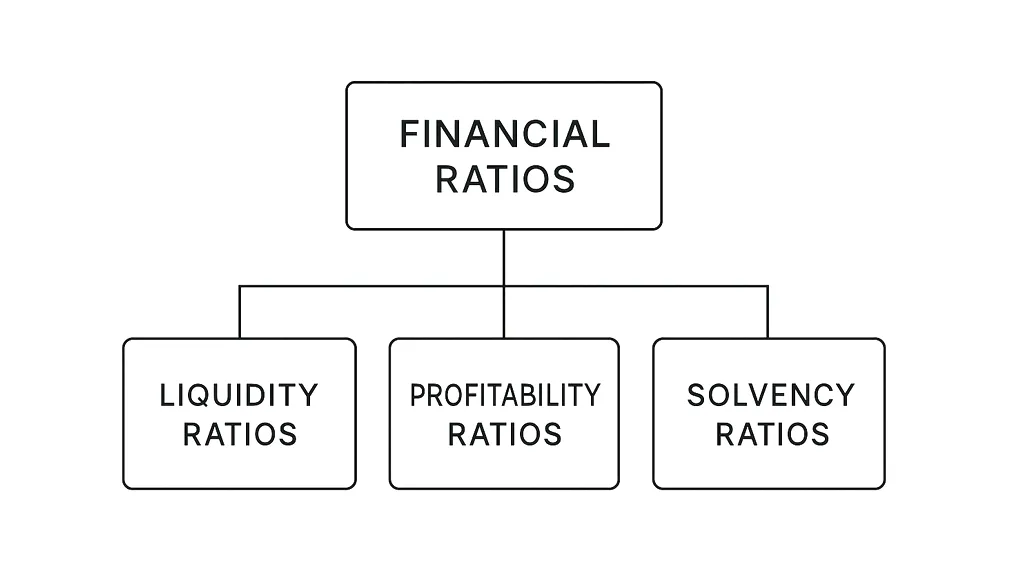
As you can see, the broad idea of financial ratios splits into specific areas of business health, which helps you organise your analysis and focus on what matters.
Liquidity Ratios: The Cash Flow Check-up
First up, we have liquidity ratios. These are all about your short-term financial stability. At their core, they answer one crucial question: "Can we pay our immediate bills over the next few months with the cash we have on hand?"
Think of it like the cash in your wallet. It's what you use for daily expenses—petrol, groceries, your flat white. You might have savings tucked away, but if your wallet is empty, you're in a bit of a pickle. A business is the same. It needs enough accessible cash to cover the day-to-day running costs, like paying suppliers and wages.
A business can be profitable on paper but still go under if it runs out of cash. Liquidity ratios are your early warning system, helping you spot a cash crunch before it turns into a full-blown crisis.
The most common one here is the Current Ratio. It simply compares your current assets (like cash and inventory) to your current liabilities (bills due within a year). In New Zealand, this is a metric that gets a lot of attention. Data from 2013 to 2024 shows the current ratio for Kiwi financial institutions consistently sat around 50% of total current liabilities, a sign of stable liquidity in the sector. You can dig into more of these financial stability trends for New Zealand businesses on Figure.NZ.
Solvency Ratios: Checking the Foundations
Next are solvency ratios, sometimes called leverage ratios. These take a much longer-term view of your financial health. They're designed to answer: "Is our business built to last, and can we meet our long-term debt commitments?"
If liquidity is the cash in your wallet, solvency is the strength of your house's foundation. A solid foundation means the house can handle a storm and will still be standing in decades. In the same way, strong solvency means your business has a healthy balance of debt and equity, allowing it to ride out economic slumps and stick around for the long haul.
- Debt-to-Equity Ratio: This classic ratio compares your total debt to the total equity from shareholders. It tells you how much of your business is funded by lenders versus owners.
- Interest Coverage Ratio: This one checks if your profits are big enough to comfortably cover the interest payments on your loans. It’s a direct measure of how well you’re managing your debt.
Banks and lenders look very closely at these ratios because they reveal the level of risk tied to your business.
Profitability Ratios: The Final Score
This is the category most people are familiar with. Profitability ratios do exactly what they say on the tin—they measure how good your business is at making money. The question they answer is simple: "Are we actually making a profit from what we sell?"
Think of profitability like the final score in a rugby match. Did you win or lose, and by how much? These ratios cut through all the noise of revenue and expenses to show you how much profit you're actually banking from every dollar of sales.
There are a few key ways to measure this:
- Gross Profit Margin: This shows the profit you make on your products or services after subtracting the direct costs of producing them. It’s a fantastic way to gauge your pricing and production efficiency.
- Net Profit Margin: This is the big one—the bottom line. It shows what percentage of revenue is left after all expenses, including taxes and interest, have been paid. It’s the ultimate report card on your company’s overall profitability.
Tracking these over time is essential. If your profit margin starts to slide, it's a huge red flag that something needs fixing, whether it’s rising costs, pricing pressure, or problems in your operations.
Efficiency Ratios: How's the Engine Running?
Finally, we have efficiency ratios, also known as activity ratios. These measure how well your business is using its assets to generate revenue. The central question here is: "Are we getting the most bang for our buck from our resources?"
Imagine your business is a car. Efficiency ratios are like its fuel economy—the kilometres per litre. It’s not just about having a full tank (liquidity) or a sturdy chassis (solvency); it’s about how efficiently the engine turns fuel into forward motion.
- Asset Turnover Ratio: This measures how much revenue you generate for every dollar of assets you own. A higher number is better, suggesting you’re sweating your assets to make sales.
- Inventory Turnover Ratio: For any business holding stock, this is vital. It shows how many times you sell and replace your inventory over a certain period. It’s a great indicator of how well you're managing stock and avoiding cash being tied up on shelves.
By getting a handle on these four categories, you can start to piece together a really clear, insightful picture of how your business is performing. You’ll be ready to go beyond just looking at numbers and start understanding the story they tell.
Let's Get Our Hands Dirty: Calculating and Interpreting Ratios with Real Examples
Theory is all well and good, but the real "aha!" moment comes when you see financial ratio analysis in action. So, let's roll up our sleeves and crunch some numbers. We'll walk through how to calculate one key ratio from each of the four main categories we've talked about.
To keep things practical, we’ll invent a fictional Kiwi business: 'Kiwi Cafe,' a bustling spot in Wellington. I’ll give you the simple formulas, we’ll plug in the numbers from their books, and then we’ll break down what it all actually means.
https://www.youtube.com/embed/TZZFBkbC2lA
Remember, the calculation is just step one. The real magic is in the interpretation—turning that number into a story about your business. What does a Current Ratio of 2.1 really mean for the cafe's ability to pay its suppliers on time? Is a Net Profit Margin of 15% a reason to pop the bubbly or a sign that costs are getting out of hand? Let's translate these figures into plain English.
Kiwi Cafe Financial Ratio Calculation Examples
Here's a quick table showing how we can calculate and understand four essential ratios for our cafe. We'll dive into each one in more detail right after.
| Ratio Name | Formula | Example Calculation | What It Means |
|---|---|---|---|
| Current Ratio | Current Assets / Current Liabilities | $42,000 / $20,000 = 2.1 | The cafe has $2.10 in short-term assets for every $1 of short-term debt. Healthy! |
| Net Profit Margin | (Net Income / Revenue) x 100 | ($45,000 / $300,000) x 100 = 15% | After all costs, Kiwi Cafe keeps 15 cents of profit from every dollar of sales. Very strong for a cafe. |
| Debt-to-Equity Ratio | Total Liabilities / Shareholder's Equity | $50,000 / $80,000 = 0.625 | The business is funded more by owners than lenders, with about 63 cents of debt for every $1 of equity. |
| Asset Turnover Ratio | Net Sales / Average Total Assets | $300,000 / $120,000 = 2.5 | Kiwi Cafe generates $2.50 in sales for every $1 invested in assets. That’s efficient! |
By looking at these numbers together, a clear picture of a well-run, financially sound business starts to emerge. Now let's explore each one a bit more.
Liquidity Example: The Current Ratio
First up, let's take a peek at Kiwi Cafe's short-term financial health. The Current Ratio is the perfect tool for this, as it quickly tells us if the cafe has enough cash and other current assets to cover its immediate bills.
The formula couldn't be simpler:
Current Ratio = Current Assets / Current Liabilities
Let's imagine after a look at its balance sheet, Kiwi Cafe has these figures:
- Current Assets: $42,000 (This is all their cash, coffee bean and food inventory, and a few invoices owed by corporate catering clients.)
- Current Liabilities: $20,000 (This includes upcoming payments to suppliers, wages due to staff, and short-term loan repayments.)
Now, we just pop those numbers into the formula:
Calculation: $42,000 / $20,000 = 2.1
So, what on earth does 2.1 mean? It tells us that for every $1 of bills due soon, Kiwi Cafe has $2.10 in easily accessible assets to pay them. Anything between 1.5 and 2.5 is generally seen as a healthy spot to be in. This result suggests the cafe can sleep well at night, knowing it can handle its immediate bills without any stress.
Profitability Example: The Net Profit Margin
Next, how good is Kiwi Cafe at actually making money from all those flat whites and scones it sells? The Net Profit Margin is the ultimate scorecard for this, showing what percentage of sales is left over as pure profit after every single expense is paid.
Here’s the formula:
Net Profit Margin = (Net Income / Revenue) x 100
To work this out, we need to grab some figures from the cafe's profit and loss statement. If that document is still a bit of a mystery to you, our guide on how to read profit and loss statements is a fantastic place to start.
Let’s assume these numbers for Kiwi Cafe:
- Revenue (Total Sales): $300,000
- Net Income (The final profit after all costs): $45,000
Let's do the maths:
Calculation: ($45,000 / $300,000) x 100 = 15%
A Net Profit Margin of 15% means that for every dollar that comes through the till, Kiwi Cafe gets to keep 15 cents as pure profit. It’s a direct measure of how well the business is running.
Whether 15% is good or not really depends on the industry. In the notoriously tough and competitive cafe world, this would likely be seen as a fantastic result, pointing to smart pricing and tight control over expenses.
Solvency Example: The Debt-to-Equity Ratio
Time for the long-term view. The Debt-to-Equity Ratio helps us figure out how the cafe is funding its growth. Is it relying more on bank loans or money from its owners?
The formula is:
Debt-to-Equity Ratio = Total Liabilities / Shareholder's Equity
Pulling from Kiwi Cafe's balance sheet, we find:
- Total Liabilities (every cent it owes, short- and long-term): $50,000
- Shareholder’s Equity (the owner's stake): $80,000
The calculation is straightforward:
Calculation: $50,000 / $80,000 = 0.625
A ratio of 0.625 tells us that for every dollar the owners have put into the business, the cafe has borrowed about 63 cents. Lenders and investors generally prefer a lower ratio (typically under 1.0), as it shows the business isn't overly reliant on debt. It’s a sign of stability. If you're looking to borrow, it also pays to understand what constitutes a good Debt Service Coverage Ratio (DSCR) for loan approval, which gives another angle on how lenders assess your debt situation.
Efficiency Example: The Asset Turnover Ratio
Finally, let's see how hard Kiwi Cafe's assets—like its coffee machine and kitchen gear—are working to generate sales. The Asset Turnover Ratio is the perfect metric for this.
It's calculated like this:
Asset Turnover Ratio = Net Sales / Average Total Assets
We've got the following numbers:
- Net Sales (Revenue): $300,000
- Average Total Assets: $120,000 (You find this by adding the asset value at the start and end of the year, then dividing by two.)
And the calculation:
Calculation: $300,000 / $120,000 = 2.5
An Asset Turnover Ratio of 2.5 means Kiwi Cafe generates $2.50 in sales for every $1 it has tied up in assets. A higher number is usually better, as it shows the business is getting a lot of bang for its buck from its equipment, cash, and other resources.
As you can see from these examples, financial ratio analysis isn't about scary, complicated maths. It’s about using simple formulas to uncover the powerful stories hidden in your numbers, giving you the clarity you need to build a stronger, more profitable business.
Common Mistakes to Avoid in Your Financial Analysis

Getting comfortable with financial ratio analysis is a massive step forward for any business owner. But like any powerful tool, it’s easy to make a few common mistakes that can send your analysis completely off track. Think of this as your guide to sidestepping those pitfalls, helping you move from just crunching numbers to making genuinely smart business decisions.
The biggest trap? Focusing too heavily on a single ratio.
Judging your entire business on just one number is like deciding a car is perfect based only on its colour. A fantastic profitability ratio might look great, but it doesn't mean much if your liquidity is so poor you can’t pay your suppliers next week. A single ratio is just one piece of the puzzle. The real insight comes from seeing how different ratios work together to tell the full story of your business's health.
Relying on a Single Snapshot in Time
Another classic error is analysing your ratios for just one period—like a single month or quarter—and treating that as the final word. A business is a moving, breathing thing, and its financial health changes constantly. A single snapshot in time just doesn’t show you the direction you're heading.
Are your profit margins getting better or worse? Is your debt slowly creeping up? You can only answer these critical questions by tracking your ratios over time. This trend analysis is where the real gold is. It helps you see patterns, spot potential problems before they become disasters, and confirm that your strategic changes are actually working.
Don't just take a photo of your business's health; watch the movie. Consistent tracking over several periods is what turns financial ratio analysis from a simple check-up into a powerful strategic tool.
Comparing Apples to Oranges
It’s natural to want to know how your business stacks up against the competition. This is called benchmarking, and it's incredibly useful—when done correctly. The mistake is comparing your numbers to businesses in completely different industries. A software company, for example, will have drastically different asset turnover and inventory ratios compared to a retail shop. It’s a pointless exercise.
To get any meaningful insight, you need to compare your business to others of a similar size and in the same industry. Here are a few ways to find relevant benchmarks:
- Industry Associations: Many NZ industry groups publish anonymous financial performance data for their members.
- Stats NZ: Statistics New Zealand offers broad industry-level data that can be a useful starting point.
- Your Accountant: An experienced accountant often has access to databases and a deep understanding of what's considered "normal" for your sector.
Forgetting the Story Behind the Numbers
Finally, and this is probably the most important one, you can't forget that numbers don't tell the whole story on their own. What is financial ratio analysis if not a tool to prompt deeper questions? A sudden dip in your net profit margin might look alarming at first glance.
But what if that dip was caused by a deliberate, strategic investment in a new marketing campaign designed to triple your leads? Or what if you bought new equipment that will boost efficiency for years to come? In that context, the lower profit isn't a failure; it's a planned investment in future growth.
You always have to dig deeper and ask "why?" behind the numbers to understand the full picture.
Time to Put Financial Ratios to Work for Your Business
So, we’ve covered the ins and outs of financial ratio analysis, and hopefully, one thing is really clear by now. This isn't just some dusty old accounting task; it's a practical, hands-on toolkit for building a stronger, smarter, and more resilient business. You now hold the keys to understanding the real story your numbers are telling.
From a quick health check on your cash flow with liquidity ratios to a long-term stability test using solvency ratios, you're now equipped to see the bigger picture. Throw in profitability and efficiency ratios, and you get a complete view of how well you're turning sales into actual profit and assets into action.
Think of financial ratio analysis as the bridge between your raw financial data and your best strategic decisions. It turns numbers on a page into a clear roadmap for where you're heading.
Ready to roll up your sleeves? You don't need to be a seasoned accountant to start. Taking that first step is much easier than you might think, and it can have a huge impact on your business's future. For more ideas on what to track, check out our guide to important financial KPIs for small business.
Your Simple Three-Step Plan
Getting started is as easy as one, two, three. Here’s a quick plan to get you going:
- Gather Your Tools: Grab your essential financial statements – your balance sheet and your profit and loss statement.
- Start Small: Don't try to boil the ocean. Just pick one or two ratios that feel most important right now, like the Current Ratio or Net Profit Margin.
- Track and Learn: Calculate them regularly and watch what happens over time. The real magic isn't in a single number, but in the trends you'll start to see.
Got Questions? We’ve Got Answers
Even after getting the hang of the basics, Kiwi business owners often have a few nagging questions when they first dive into financial ratio analysis. Let's tackle some of the most common ones with some straightforward, practical answers.
How Often Should I Actually Do This?
For most small to medium-sized businesses in New Zealand, running the numbers quarterly is a fantastic rhythm to get into. It’s frequent enough to catch trends or problems before they snowball, but it won’t completely take over your life.
That said, if your business is in a fast-paced industry or you're keeping a close eye on cash flow, a monthly check-in on your most critical ratios (like liquidity) is a smart move. At the very least, a deep-dive analysis at the end of your financial year is non-negotiable for reviewing how you went and planning for the year ahead.
Where Do I Find Industry Benchmarks?
Knowing how you stack up against the competition is crucial, but finding that data can feel like a mission. The good news is, there are a few go-to spots.
- Statistics New Zealand (Stats NZ): A great place to start for high-level industry financial data to get a general idea of the landscape.
- Your Industry Association: Most industry bodies publish reports for their members, often packed with juicy financial performance stats.
- Talk to Your Accountant: A good accountant is worth their weight in gold here. They often have access to specialised data and, just as importantly, see what's working (and what's not) for businesses just like yours.
The point of benchmarking isn't to be a perfect copy of your competitors. It's about getting the context behind your numbers so you can start asking the right questions about your own performance.
Can My Accounting Software Do This For Me?
You bet it can. Modern accounting software is a game-changer here. Platforms like Xero or MYOB have reporting tools that can crunch these key ratios for you automatically, straight from your financial data.
Often, they’ll spit out the results in easy-to-read dashboards with graphs and charts, making it simple to see how you’re tracking over time. But remember, while the software does the maths, your understanding of what financial ratio analysis is remains the most important part. You’re the one who needs to turn those numbers into savvy business decisions.
Making sense of your financial data can feel like a lot, but you don't have to go it alone. The team at Business Like NZ Ltd are experts at helping small and medium-sized businesses across New Zealand understand their numbers and map out a clear path to financial success. Get in touch with us today for expert business advice.